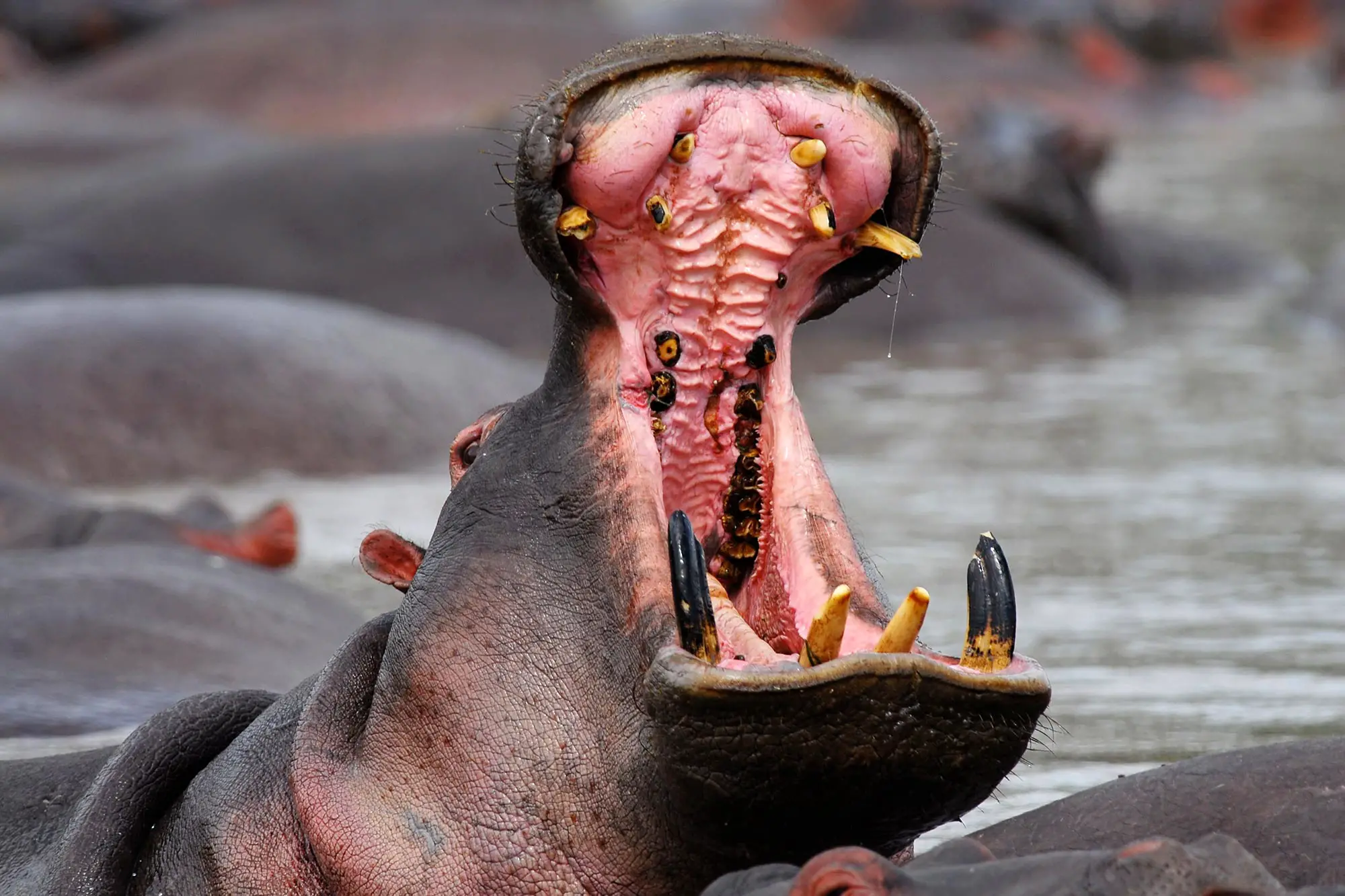
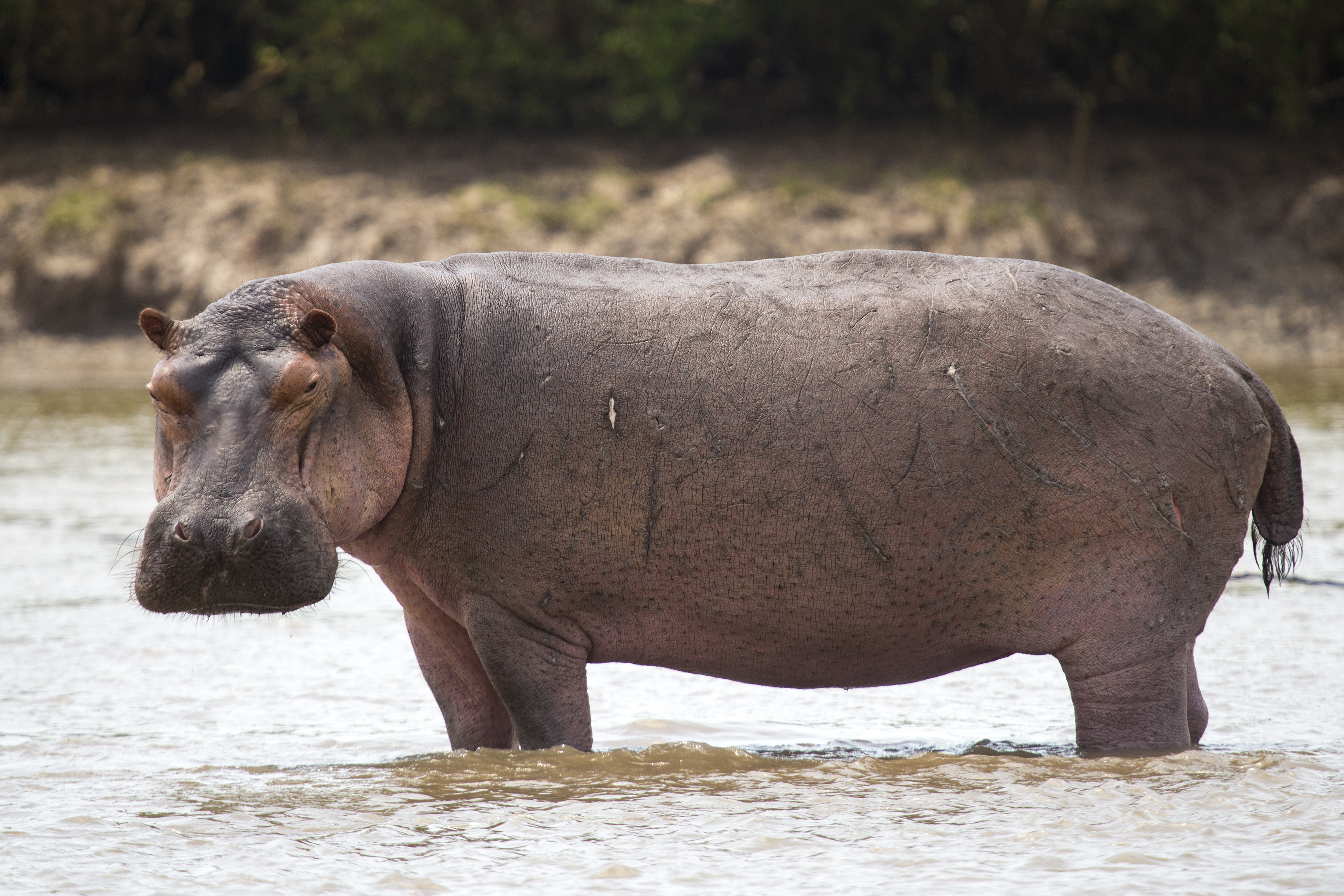
The hippopotamus has a very simple exterior. It is characterised by grey or brown thin; hairless skin; a small tail, a pink underbelly; a bulky; barrel-shaped body, short stumpy legs; webbed feet;
folds of skin; small, brownish-pink ears and eyes; tusks, a large head, large muzzle; large closable nostrils and a large mouth that can open up to 1.2 metres. Hippos also have two pairs of tusks that can be found in the lower jaw. The tusks of the male hippos are slightly bigger than those of the female hippo.
The jaw of a hippo is a fascinating part of its body. As mentioned, the jaw of a hippo is large. Its force comes for a large masseter
(a paired, thick, rectangular muscle) and a developed digastric (a muscle found at by the lower jaw). The digastric is right behind the masseter. The mouth is able to open at almost 180 degrees because the jaw hinge is located at the very back. The bite force of an adult hippo is around 8100 newtons.
The average weight of an adult hippo is estimated to be anything between 1500 kilograms and 3200 kilograms. Females reach between 1500 kilograms and 1800 kilograms; while males can average a larger size. The average length of a hippo is between 2.5 meters and 3.5 meters.
Hippos are born weighing between 28 kilograms and 50 kilograms. Male hippos continue to grow in weight and length while the female hippo stops growing around the age of 25.